
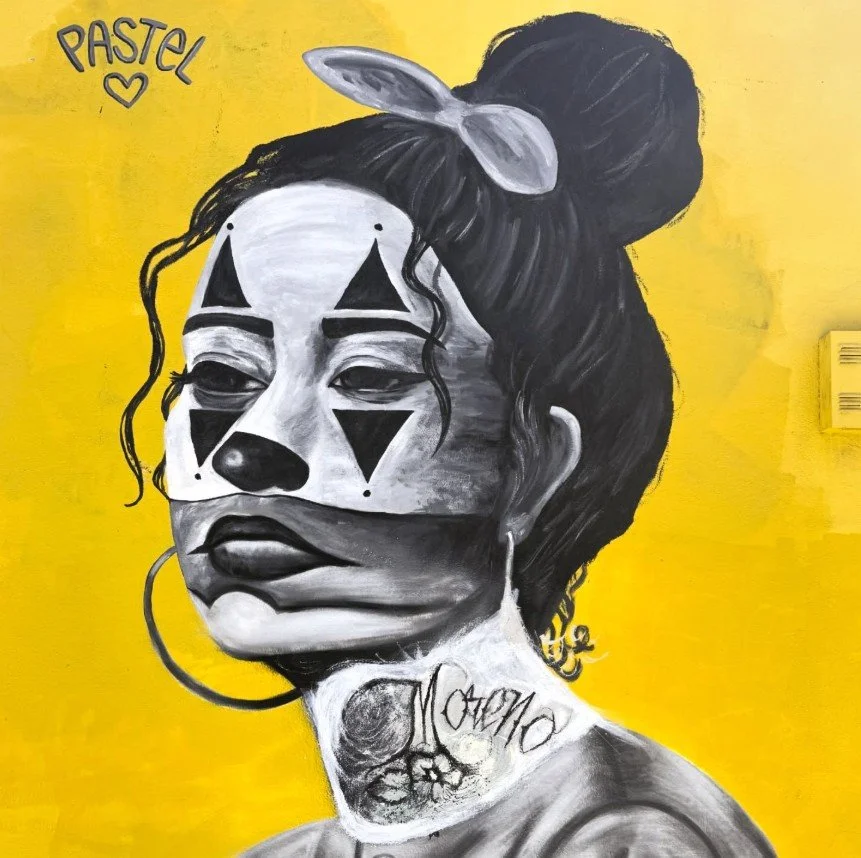
What registers immediately is control — earned through serious repetition on unforgiving surfaces. Pastel Ohwell works the wall the way a sculptor works stone: decisive in mark. The figure emerges from a flat saturated ground in a single dominant value range — charcoal black to mid-grey — referencing the black-and-grey tradition of Chicano tattooing and prison art. Precise at the mask geometry, looser through the hair, the aerosol breathes where anatomy no longer demands structure. That graduated looseness is pacing, not carelessness.
Two colors form the entire palette. The warm cadmium yellow ground — flat, unblended, absolute — functions as sunlight trapped in amber. Against it, the monochrome figure appears to press forward, occupying the same plane as anyone standing before it. Black and yellow carry centuries of coded weight here, producing the visual temperature of Southern California afternoon light and the psychological temperature of being seen without apology.
"Pastel Ohwell is not illustrating a culture — she is translating one, from the interior language of community self-representation into the grammar of a public wall."
Iconography & Cultural Resonance
Central to the image is the payasa — the clown mask — and this is where the work earns its depth. Within Chicana visual culture, the masked clown carries specific historical freight: originating in barrio tattoo traditions of the 1970s–90s, it embodies duality — the performance of toughness in the street, and the grief held beneath. Pastel Ohwell complicates this: the expression under the mask is neither smile nor collapse. It is suspended. Unreadable. That ambiguity is the point.
The mask's hard geometric triangles read simultaneously as clown face paint and pre-Columbian motif — Aztec geometry that survives in Chicano visual vocabulary, transforming the face into something ceremonial. The neck tattoo closes the composition: "Moreno" — a surname, but also a color word meaning dark-skinned, brown. An act of naming and claiming in a single word.
Community Impact & Cultural Moment
Murals in Pomona's 909 are not gentrification markers. They exist because the community demands to see itself. Pastel Ohwell's work enters a longer tradition of Chicana artists who have insisted that the feminine, Brown, working-class body is a worthy subject of serious art. In the current national climate — openly hostile toward immigrant and Brown communities — painting this face large, unhidden, unsmiling, and unmoved is a political act, whether or not it was framed as one. Visibility, right now, is resistance.
What keeps the piece from collapsing into statement is that it remains, first and last, a portrait. A specific face, with a specific name in its skin. It belongs exactly where it is, and it would hold its own anywhere.
Untitled (Payasa) — Moreno
Artist Pastel.Ohwell
Location Pomona, CA
Medium Aerosol on Concrete
Year 2025