
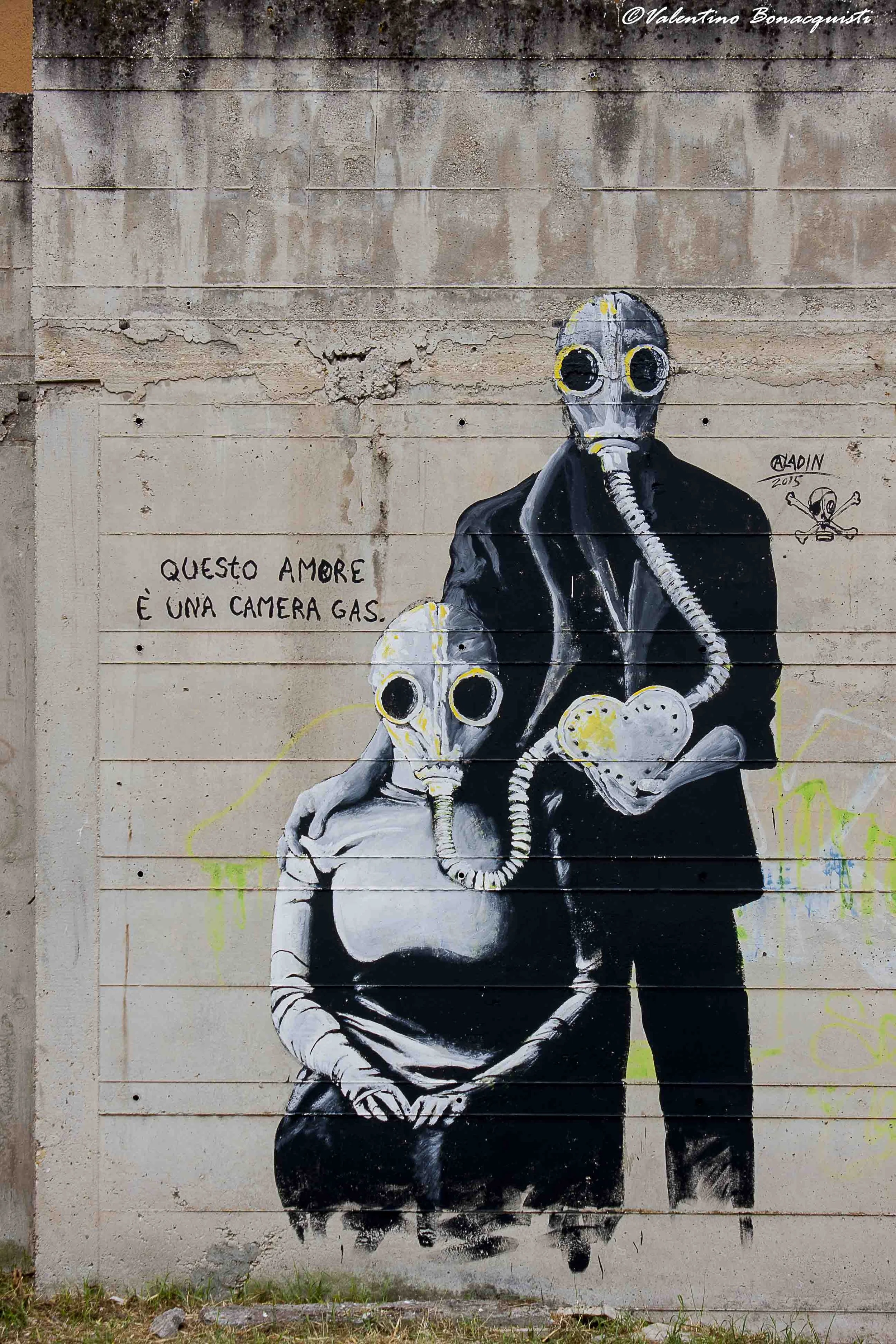
Mammut a Rebibbia-2 (2015)
Aladin Hussein Al-Baraduni | Rome, Italy
Photography: Valentino Bonacquisti (@fotografiaerrante)
Questo amore è una camera gas. This love is a gas chamber. Six words, hand-stenciled in plain block type, hung to the left of two figures that make the declaration feel almost redundant. Almost.
On the Wall
The support here is raw poured concrete, sectioned by horizontal expansion joints that function almost as musical staves across the façade. Rebibbia is a northern Rome neighborhood most widely known for its prison complex — a fact that charges the location with considerable weight. Al-Baraduni's approach to the wall is architectural: he works with its horizontal lines rather than against them, allowing the scored surface to read as visual rhythm beneath the figures. The palette is deliberately austere — near-total monochrome in ivory, charcoal, and flat black — punctured only by the cadmium yellow of the gas mask lenses. That yellow is doing a lot of work. It reads as the single surviving frequency of warmth in an otherwise drained scene: eyes without irises, biological life reduced to optical hardware.
The rendering style is confident and economical. Al-Baraduni has spoken openly about his gas mask iconography as simultaneously a critique of urban pollution and an exhortation toward protest — a figure armored for a city that has become unbreathable, in more than the literal sense. The technique draws from the Italian fresco tradition — large-format figurative work meant to be read at a distance, with strong silhouette edges and deliberate tonal blocking — while remaining unmistakably of the street. The figures are painted, not stenciled, with gestural confidence and a painterly hand that rewards close looking without requiring it.
What the Piece Is Saying
Two figures. A couple, presumably — the formal composition echoes Renaissance portraiture, specifically the kind of paired devotional image where social station is communicated through posture and placement. The standing figure behind, broader, darker, holds a heart — not a symbol of affection here but something more like an organ removed and presented on a tray. The seated figure leans slightly inward. Both wear gas masks. Both breathe through corrugated tubes. Their intimacy, such as it is, runs through filtration systems.
Al-Baraduni has consistently characterized his gas mask figures as messages of encouragement, representations of conflict designed to recall the warmth of complicity — the feeling of being inside a movement, a cause, a moment of collective resistance. Read through that lens, the piece isn't primarily about romantic toxicity, though it functions brilliantly there too. It's about survival as a relational act — two people who cannot breathe the same air as the world around them, sealed inside a shared system, dependent on each other's filters to stay alive.
The text anchors it differently depending on who reads it. To a Roman passerby in 2015, it might register as a bruised love poem — the kind of sardonic lyric that circulates in a city where sentimentality and cynicism have always been close neighbors. To anyone arriving from a country at war, from a refugee camp, from a housing squat on the periphery of a European capital — the camera gas lands in a completely different part of the body.
Why It Still Matters
Al-Baraduni's work has been shown at the Venice Biennale in both 2016 and 2022, and yet Mammut a Rebibbia-2 resists the institutionalization that tends to follow artists who get that kind of attention. It was made for a concrete wall in a neighborhood built around incarceration. It requires nothing from you but your presence. He has been openly opposed to galleries charging admission — his position is that the mural reaches people faster, more directly, without the toll booth of cultural access.
Mammut a Rebibbia-2 is a portrait of endurance dressed as a love story. It asks, without sentimentality, what it means to stay together — as people, as communities, as species — when the air between you has already turned.
@aladin_al_baraduni | Photography © Valentino Bonacquisti (@fotografiaerrante) | Rome, 2015